
For decades, dentists worked with 2-D X-rays. They were helpful, but limited. Imagine trying to understand a complex 3-D structure from a flat shadow. That’s basically what we were doing. CBCT 3-D imaging for dental treatment changed everything. And we’re proud to use it right here in our Bryn Mawr dental office.
Let’s talk about what CBCT is, how it works, and why it makes dental treatment safer, faster, and more precise than ever.
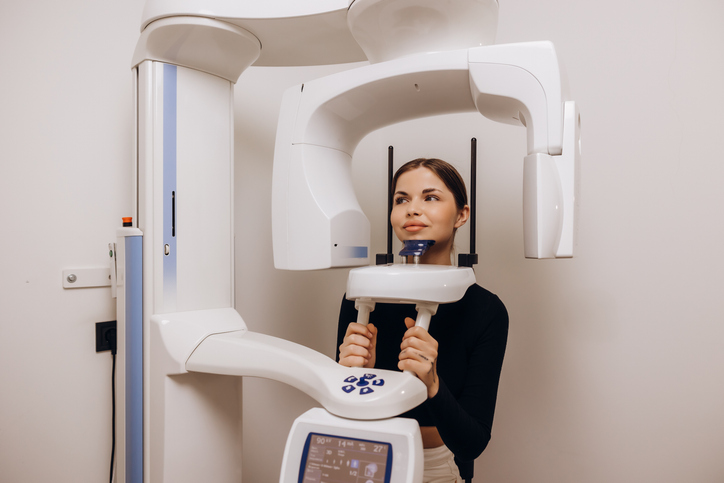
What Is CBCT?
CBCT stands for Cone Beam Computed Tomography. It’s a type of 3-D imaging that gives us a complete, detailed picture of your teeth, jawbone, sinuses, and surrounding structures.
Unlike a traditional CT scan you might get at a hospital, CBCT is designed specifically for dentistry. It uses a cone-shaped X-ray beam that rotates around your head. In just seconds, it captures hundreds of images. Then software pieces them together into a 3-D model we can rotate, zoom, and examine from every angle.
How Is It Different From Regular X-Rays?
Regular dental X-rays are 2-D. They show us a flat image. We can see cavities and some bone loss, but we can’t see depth.
CBCT shows us everything in three dimensions. We can:
- Look at your jaw from the front, the side, the top, and even from inside
- Measure bone density
- See exactly where nerves and blood vessels run
- Spot problems that would be invisible on a 2-D image
It’s like the difference between looking at a map and looking at a scale model of a city. Both are useful, but one gives you a much deeper understanding.
How We Use CBCT in Our Practice
We use CBCT for many reasons. Here are the big ones.
- Implant planning: Placing a dental implant requires precision. We need to know exactly where the bone is thick enough. We need to avoid nerves. CBCT lets us map everything out before we ever make an incision. Dr. Ana Kodra uses this imaging to plan implant placement with incredible accuracy.
- Root canal treatment: Teeth have complex root systems. Some have extra canals. Some curve in unexpected directions. CBCT shows us the anatomy before we start a root canal, so our endodontists, Drs. Toni Chen, Tina Chou, and Sepideh Noorani, can clean and seal every canal with confidence.
- Apicoectomy planning: When we perform an apicoectomy, we need to see the root tip and surrounding bone clearly. CBCT gives us that view before surgery, so we can plan the safest approach.
- Diagnosing infections: Sometimes an infection is hidden. It might not show up on a regular X-ray. CBCT reveals the source and extent of the problem, so we can treat it effectively.
- Evaluating bone loss: For patients with gum disease, CBCT helps us measure bone loss and track changes over time.
The Benefits for You
Here’s what this technology means for you as a patient.
- Safer treatment: We can see exactly what we’re doing before we do it. That reduces the risk of complications.
- Fewer surprises: We plan ahead. We know what we’re walking into. That means fewer unexpected discoveries during treatment.
- Faster appointments: With better information upfront, we can work more efficiently. That’s better for everyone.
- Lower radiation: CBCT uses less radiation than a traditional medical CT scan. It’s safe and quick.
- Better outcomes: Precision leads to better results. That’s true for implants, root canals, and everything in between.
Is CBCT Safe?
Yes. CBCT is safe. The radiation dose is low, comparable to a few days of natural background radiation. We only take images when they’re needed. And we follow strict safety protocols to protect you.
If you’re pregnant or think you might be, just let us know. We’ll adjust our approach to keep you and your baby safe.
The Future Is Already Here
We’ve been early adopters of CBCT because we believe in giving our patients the best possible care. This technology isn’t the future. It’s the present. And it’s changing how we practice dentistry every single day.
Our practice has a long history of innovation. Dr. Louis I. Grossman, our founder, wrote the first textbook on endodontics in 1940. He believed in advancing the field through knowledge and technology. We carry that same spirit forward today.
Questions About CBCT?
If you’re curious about how CBCT imaging could help with your treatment, we’d love to talk. Call us at 610-590-9250 to schedule a consultation. We’ll show you your images, explain what we see, and walk you through your options.
Technology is only as good as the people using it. And we’ve got both covered.