
If you’re missing one tooth or several, you’ve probably heard about dental implants. But you might be wondering: what exactly makes them so different from bridges or dentures? And why do so many people call them the gold standard for tooth replacement?
Let’s break it down in plain language.
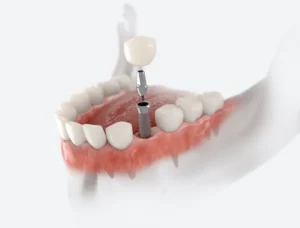
What Actually Is a Dental Implant?
A dental implant is essentially a replacement tooth root. It’s a small, biocompatible titanium post that we surgically place into your jawbone where your tooth used to be. Over time, your bone grows around that post and fuses with it, a process called osseointegration. That fusion creates a foundation that’s often just as strong and stable as a natural tooth root.
Once the implant has integrated with your bone, your dentist attaches a custom-made crown on top. The result is often a tooth that looks, feels, and functions like your own.
At Main Line Endodontics & Periodontics Associates, we handle the surgical side of this process: the placement of the implant itself. We then work closely with your general dentist, who will create and place the final crown. It’s a partnership designed to give you the best possible outcome.
Why Choose Implants Over Other Options?
Traditional bridges and dentures have their place, but they come with trade-offs. A bridge requires shaving down the healthy teeth next to the missing one to support the restoration. Dentures, while non-invasive, can slip or affect your speech, and they never quite match the chewing power of natural teeth.
Implants avoid those downsides. They:
- Preserve your bone. When a tooth is missing, the jawbone in that area begins to deteriorate over time. An implant stimulates that bone, keeping it healthy and preventing the sunken appearance that can happen with long-term tooth loss.
- Leave neighboring teeth untouched. No drilling or altering of healthy teeth is required.
- Restore full chewing function. You could eat what you love without worry.
- Last for decades. With proper care, implants can last a lifetime, far longer than bridges or dentures.
What Makes Our Approach Different?
This is where our practice’s unique combination of specialties comes into play. Dental implant placement sits right at the intersection of periodontics and endodontics, and we have experts in both under one roof.
Our periodontist, Dr. Ana Kodra, brings specialized training from the University of Pennsylvania in both Periodontics and Periodontal Prosthesis. That means she doesn’t just place implants; she understands the complex relationship between your gums, bone, and the restoration itself. She is the one who ensures your foundation is healthy and ready.
Our endodontic team, including Dr. Toni Chen, Dr. Tina Chou, Dr. Sepideh Noorani, and Dr. Greg Newman, focuses on preserving natural teeth whenever possible. But when a tooth cannot be saved, they work alongside Dr. Kodra to ensure the transition to an implant is seamless.
We also rely on technology that most general dental offices don’t have. Before we ever place an implant, we use CBCT 3-D imaging to map your jawbone in three dimensions. This allows us to determine the exact location, angle, and depth for placement, all before the procedure begins. Precision like this means fewer surprises and better long-term results.
What to Expect
If you’re considering implants, your journey begins with a consultation. We’ll review your medical history, take a 3-D image of your jaw, and evaluate your gum health. If there has been bone loss, we may recommend a bone graft first, a routine procedure that creates a solid foundation for the implant.
The implant placement itself is done with local anesthesia. Most patients describe the experience as similar to having a tooth extracted, often with less discomfort than they expected. After placement, you’ll heal for several months as the implant fuses with your bone. Once healed, your general dentist will complete the process by placing your custom crown.
A Legacy of Innovation
Our practice has been part of the Philadelphia area’s dental community since the 1930s, when Dr. Louis I. Grossman, first began treating patients. Today, that legacy of excellence continues with a team of specialists dedicated to helping you keep your smile healthy, functional, and complete.
If you’re missing a tooth or have been told you’re not a candidate for implants, don’t assume the door is closed. Schedule a consultation with us. We’ll take a look, show you your 3-D images, and walk you through what’s actually possible.