
You’ve probably heard of a root canal. But have you ever heard of an apicoectomy?
If your dentist mentioned this word and you’re feeling confused, you’re not alone. It’s one of those procedures that sounds complicated. But once we break it down, it’s actually pretty straightforward. Let’s talk about what an apicoectomy is, why someone might need one, and what you can expect if we recommend it.
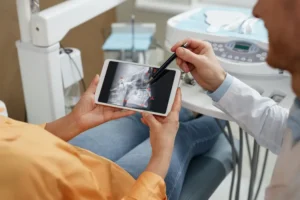
First, Let’s Define It
“Apicoectomy” comes from two parts. “Apico” means the tip of the root. “Ectomy” means removal. An apicoectomy is a surgery where we remove the very tip of a tooth’s root.
Why would we do that? Because that’s where infection can hide. And sometimes, a standard root canal just isn’t enough to get it all.
Why Would a Root Canal Not Be Enough?
A root canal cleans and seals the inside of your tooth. It works great for most people.
But teeth aren’t always simple. Some have tiny branches or fractures near the root tip. Bacteria can hide in those spots. A traditional root canal cleans from the top down. But it can’t always reach those tricky areas at the very bottom.
When that happens, infection can linger. You might not feel pain right away. But over time, it can cause problems like:
- A small bump or pimple on your gum
- Swelling or tenderness in that area
- Pain when you bite down
- Bone loss around the root tip
If you’ve already had a root canal and still have symptoms, an apicoectomy might be your best option.
Here’s What Happens During the Procedure
We know “surgery” sounds scary. But in our hands, an apicoectomy is a minor procedure. We do them regularly in our Bryn Mawr office. Here’s how it works:
- First, we numb the area completely. You shouldn’t feel a thing.
- Then we make a tiny incision in your gum near the tooth. This gives us access to the root tip underneath.
- Once we can see the root, we remove that infected tip. We also clean out any infected tissue around it.
- Then we place a small filling to seal the end of the root.
- Finally, we stitch your gum back into place. The whole thing usually takes about 30 to 60 minutes.
Why Choose Our Office for This?
An apicoectomy requires precision. The root tip is small. The surrounding bone and nerves are delicate. That’s why we use tools most general dentists don’t have.
We use a dental microscope during the procedure. This gives us incredible magnification and lighting. We can see every detail, which means we can be more precise and protect the healthy tissue around the tooth. We also use ultrasonic instruments to gently remove the infected tip without damaging the tooth itself. And for some patients, we use our Fotona laser to help with healing.
Our endodontic team has extensive training in microsurgery. It’s what we do every day.
What About Recovery?
Recovery is usually easier than people expect. You might have some mild swelling or discomfort for a day or two. Over-the-counter pain relievers usually handle it just fine.
We’ll give you instructions to follow. You’ll want to stick to softer foods for a few days. And we’ll schedule a follow-up visit to remove your stitches and check on your healing.
Most patients are back to their normal routine within a couple of days.
Is an Apicoectomy Always the Answer?
Not always. We only recommend it when it’s the best option for saving your tooth.
Sometimes a tooth is too damaged. Maybe there’s a vertical fracture running down the root. Or maybe too much bone has been lost. In those cases, extraction might be the better choice.
But if extraction is necessary, we can handle the next step too. Our periodontist can evaluate you for a dental implant. All right here in our office.
Think You Might Need One?
If you’ve had a root canal and still have pain or swelling, don’t ignore it. Call us at 610-590-9250 to schedule an evaluation. We’ll take a look with our CBCT 3-D imaging, see exactly what’s happening, and tell you if an apicoectomy can save your tooth.
We’ve been saving teeth on the Main Line for generations. We’d love to help save yours too.